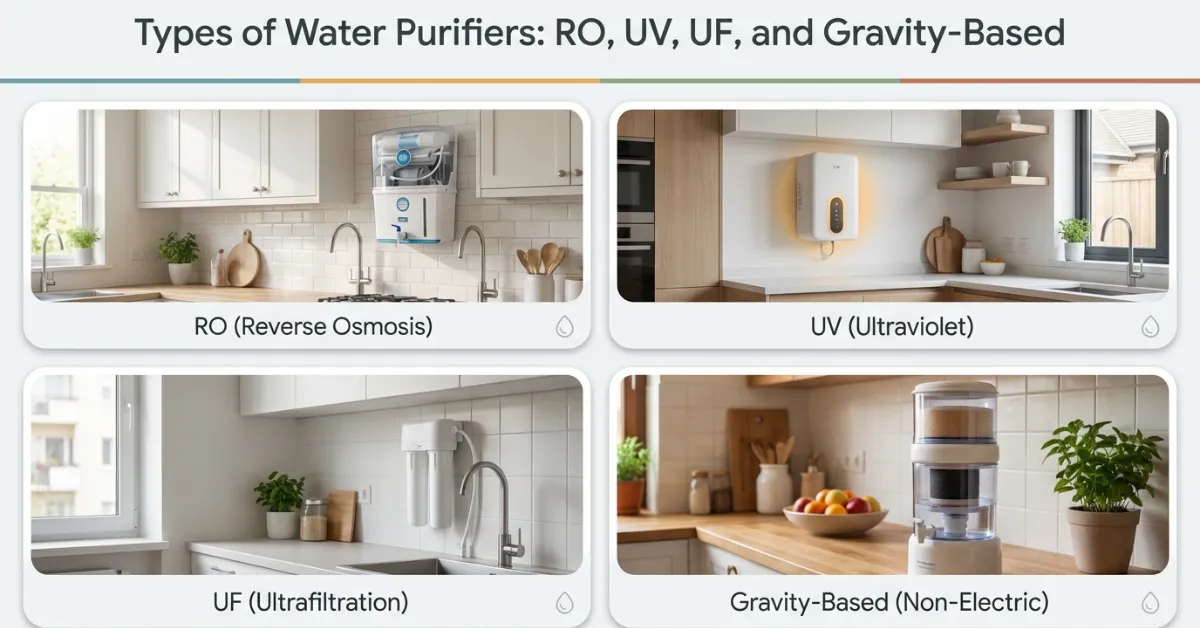
Water is essential for life, but unfortunately, not all water that reaches our homes is safe to drink. Tap water and groundwater may contain harmful impurities like bacteria, viruses, chlorine, pesticides, heavy metals, and excess dissolved salts. Consuming untreated water can lead to severe health issues such as diarrhea, kidney problems, and long-term diseases caused by chemical contaminants.
That’s why water purification methods play a crucial role in ensuring safe drinking water. In this guide, we will explain the most common types of water filtration methods used in households and industries, along with their benefits and limitations, so you can decide which water purifier is best for your needs.
Why Do We Need Water Filtration?
Clean water is more than just a basic necessity — it’s vital for health, cooking, hygiene, and even the functioning of household appliances. Some of the main reasons we need water filtration include:
- Health Protection: Removes harmful microorganisms and prevents waterborne diseases.
- Improved Taste & Odor: Filters out chlorine and organic impurities for fresh-tasting water.
- Removal of Chemicals & Metals: Eliminates harmful contaminants like lead, arsenic, and pesticides.
- Protection from Hard Water: Prevents scaling and damage to pipes, utensils, and appliances.
- Eco-Friendly Choice: Reduces dependence on bottled water, lowering plastic pollution.
Types of Water Filtration Methods
Now, let’s explore the most popular water purification methods available today.
1. Activated Carbon Filtration
Activated carbon filters use highly porous carbon blocks or granules to trap chlorine, pesticides, and organic compounds. They work through a process called adsorption, where contaminants stick to the surface of the carbon. Advantages:- Improves taste and smell of water
- Removes chlorine and VOCs (Volatile Organic Compounds)
- Affordable and easy to maintain
- Not effective for dissolved salts and heavy metals
- Needs regular filter replacement
2. Reverse Osmosis (RO) Filtration
Reverse Osmosis is one of the most advanced water purification methods. It uses a semi-permeable membrane that allows only pure water molecules to pass through while rejecting salts, heavy metals, and other dissolved impurities. Advantages:- Removes up to 95–99% of TDS (Total Dissolved Solids)
- Eliminates heavy metals like lead, mercury, and arsenic
- Provides clear, fresh-tasting water
- Wastes some water during purification
- Removes beneficial minerals along with harmful ones
3. Ultraviolet (UV) Purification
UV purifiers use ultraviolet light to kill bacteria, viruses, and other pathogens by destroying their DNA. Since it doesn’t use chemicals, it’s a safe and eco-friendly solution. Advantages:- Destroys 99.9% of microorganisms
- No chemicals used
- Compact and energy-efficient
- Does not remove dissolved salts, heavy metals, or sediments
- Requires electricity to function
4. Ceramic Filters
Ceramic water filters are made of natural ceramic materials with tiny pores that block bacteria, dirt, and other suspended particles. These are one of the oldest filtration techniques still used in rural areas. Advantages:- Affordable and eco-friendly
- Removes bacteria and sediments
- Long-lasting and easy to clean
- Not effective against viruses or dissolved impurities
- Slow filtration speed
5. Distillation Method
Distillation purifies water by boiling it and then condensing the steam into clean water. This process removes salts, minerals, and most contaminants. Advantages:- Produces extremely pure water
- Removes heavy metals, salts, and microbes
- No need for filter replacements
- Energy-intensive and slow process
- Water may taste flat due to mineral removal
6. Ion Exchange Filtration
Ion exchange filters are commonly used in water softeners. They replace calcium and magnesium ions (responsible for water hardness) with sodium or hydrogen ions, reducing scaling and extending the life of appliances. Advantages:- Softens hard water effectively
- Prevents scale buildup in pipes and utensils
- Improves appliance efficiency
- Does not remove microbes or organic contaminants
- Requires regular regeneration with salt
How to Choose the Right Water Purification Method?
When choosing a water filter for home use, keep the following factors in mind:
- Water Source: If your water comes from a borewell with high TDS, an RO filter is best.
- Contamination Type: For microbial contamination, UV purification is ideal.
- Taste & Odor: Activated carbon filters are great for improving taste.
- Budget: Ceramic and activated carbon filters are affordable options.
- Maintenance Needs: RO systems require more upkeep compared to UV or carbon filters.

Conclusion: Which Water Filter is Best for You?
There is no one-size-fits-all answer when it comes to water purification systems. The right method depends on your water quality, source, and budget.
- Choose RO if your water has high TDS or heavy metals.
- Opt for UV if microbial contamination is a concern.
- Go for activated carbon if you want better taste and odor removal.
- Use ceramic filters if you need an affordable, eco-friendly solution.
Investing in the right water filtration system ensures clean, healthy, and safe drinking water for your family.
FAQ's
If your water source has high TDS (Total Dissolved Solids) or hardness, a Reverse Osmosis (RO) purifier is the best choice. RO removes dissolved salts, heavy metals, and hardness-causing minerals, making the water safe and palatable.
No. UV purifiers only kill bacteria, viruses, and other microorganisms. They cannot remove dissolved salts, chemicals, or heavy metals. For areas with high TDS, UV should be combined with RO or other filtration methods.
Yes, ceramic filters are affordable and eco-friendly. They are good for removing bacteria, dirt, and sediments. However, they don’t remove viruses, dissolved salts, or heavy metals, so they are more suitable for rural areas with limited contamination.
Yes, RO purifiers remove both harmful contaminants and beneficial minerals like calcium and magnesium. This can make the water taste flat. Some modern RO purifiers include a mineral cartridge to restore essential minerals.
It depends on your water source and contamination type:
- High TDS or hard water → Choose RO
- Microbial contamination → Choose UV
- Bad taste/odor → Choose Activated Carbon
- Affordable rural solution → Choose Ceramic Filter Many modern purifiers combine methods (RO + UV + Carbon) for all-round protection.