Introduction
Reverse Osmosis (RO) water purification systems have become an essential solution for ensuring safe and clean drinking water. From homes and apartments to restaurants, hospitals, and industries, RO systems play a crucial role in removing impurities and improving water quality. However, not all RO systems are the same. One of the most common questions people ask is: What is the difference between Domestic RO and Commercial RO systems?
While both systems work on the same purification principle, their design, capacity, performance, and usage are very different. Choosing the wrong type can lead to poor water quality, higher maintenance costs, or insufficient water supply. In this blog, we will clearly explain the differences between Domestic RO and Commercial RO systems, helping you make the right decision based on your needs.
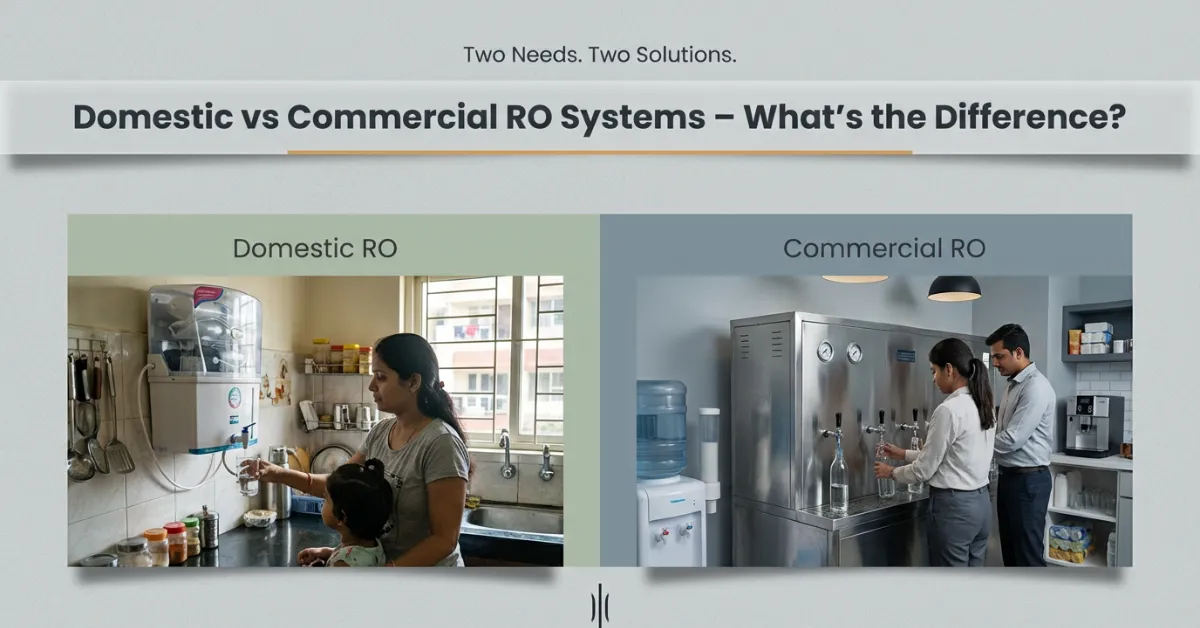
What is a Domestic RO System?
A Domestic RO system is designed for household use. It is commonly installed in kitchens and used to purify drinking and cooking water for families. These systems are compact, easy to operate, and suitable for daily household water consumption.
Domestic RO purifiers are ideal for removing dissolved salts, heavy metals, chemicals, bacteria, and viruses from water. Most home RO systems come with additional purification stages such as UV, UF, and mineral cartridges to enhance water safety and taste.
Key Features of Domestic RO Systems
- Designed for small-scale water usage
- Compact and wall-mounted or countertop design
- Usually includes RO + UV + UF purification
- Comes with a built-in storage tank
- Easy installation and low power consumption
Typical Usage Areas
- Individual homes
- Apartments
- Small families
- Drinking and cooking purposes
What is a Commercial RO System?
A Commercial RO system is built for large-scale water purification. These systems are used in places where water demand is high and continuous, such as hotels, restaurants, offices, schools, hospitals, factories, and water supply businesses.
Commercial RO plants are heavy-duty systems capable of purifying hundreds to thousands of liters of water per day. They are designed to handle high TDS water and continuous operation without performance issues.
Key Features of Commercial RO Systems
- High-capacity water purification
- Strong pumps and industrial-grade membranes
- No built-in storage tank (usually connected to external tanks)
- Suitable for continuous operation
- Customizable based on water quality and usage needs
Typical Usage Areas
- Hotels and restaurants
- Hospitals and laboratories
- Offices and corporate buildings
- Schools and colleges
- Industrial water processing units
- Bottled water plants
Core Differences Between Domestic and Commercial RO Systems
1. Water Output Capacity
One of the biggest differences lies in water production capacity.
- Domestic RO: Produces around 10–20 liters per hour (150–300 liters per day).
- Commercial RO: Produces 25 LPH to 2000+ LPH, depending on the model.
Domestic RO systems are suitable for family needs, while commercial systems are designed to meet high-volume requirements.
2. Size and Design
- Domestic RO systems are compact and aesthetically designed to fit inside kitchens or on walls.
- Commercial RO systems are larger, floor-mounted units that require dedicated space such as utility rooms or plant areas.
Commercial RO plants focus more on performance than appearance.
3. Usage Purpose
- Domestic RO: Used only for drinking and cooking water.
- Commercial RO: Used for drinking, cooking, cleaning, industrial processes, medical applications, and bulk water supply.
The purpose directly affects system size and configuration.
4. Components and Build Quality
Domestic RO systems use light-duty components suitable for limited usage. Commercial RO systems use industrial-grade pumps, membranes, and filters designed for long working hours and heavy loads.
- Domestic RO membranes usually have 75–100 GPD capacity
- Commercial RO membranes range from 300 GPD to industrial-grade membranes
5. Power Consumption
- Domestic RO systems consume less electricity and are designed for intermittent use.
- Commercial RO systems consume more power because of high-capacity pumps and continuous operation.
However, commercial systems are optimized for efficiency per liter of purified water.
6. Storage System
- Domestic RO systems have an inbuilt storage tank (usually 7–10 liters).
- Commercial RO systems usually do not have inbuilt tanks and are connected to large external storage tanks.
This allows commercial systems to store thousands of liters as required.
7. Installation Requirements
- Domestic RO installation is simple and can be completed in a few hours.
- Commercial RO installation requires professional planning, plumbing work, electrical setup, and sometimes civil modifications.
Commercial installations also involve water testing and system customization.
8. Maintenance and Servicing
Domestic RO systems require basic maintenance like filter changes every 6–12 months and membrane replacement every 2–3 years.
Commercial RO systems need:
- Regular monitoring
- Scheduled servicing
- Frequent filter replacement
- Professional maintenance support
Maintenance cost is higher for commercial RO but justified due to higher output.
9. Cost Comparison
- Domestic RO systems: Affordable and budget-friendly for households.
- Commercial RO systems: Higher initial investment due to size, components, and installation.
However, for businesses, commercial RO systems are cost-effective in the long run by reducing dependency on bottled water.
10. Customization Options
Domestic RO systems come in standard configurations.
Commercial RO systems can be fully customized based on:
- Input water TDS
- Required output capacity
- Industry type
- Water usage pattern
This flexibility makes commercial RO suitable for diverse applications.
Which RO System Should You Choose?
Choose Domestic RO If:
- You need purified water for home use
- Daily consumption is limited
- Water TDS is high
- Space availability is limited
- Budget is moderate
Choose Commercial RO If:
- You need large volumes of purified water
- Water demand is continuous
- You run a business or institution
- Water quality requirements are strict
- You want long-term bulk water solutions
Which RO System Should You Choose?
Myth 1: Commercial RO gives better water quality than Domestic RO
Truth: Both provide excellent water quality; the difference is capacity, not purity.
Myth 2: Domestic RO can handle commercial usage
Truth: Using domestic RO for commercial needs reduces lifespan and performance.
Myth 3: Commercial RO is only for industries
Truth: Commercial RO is widely used in hotels, offices, schools, and hospitals.
Environmental Considerations
Both domestic and commercial RO systems produce wastewater. However, modern systems focus on:
- Better recovery rates
- Water reuse options
- Low-waste RO technology
Commercial systems can integrate water recycling solutions for sustainable operations.
Future Trends in RO Systems
- Smart RO systems with monitoring
- Low-waste and zero-discharge RO plants
- Energy-efficient pumps
- IoT-enabled commercial RO monitoring
These innovations are making both domestic and commercial RO systems more efficient and eco-friendly.
Conclusion
Domestic and Commercial RO systems serve different purposes, even though they operate on the same technology. A Domestic RO system is perfect for households with limited water needs, while a Commercial RO system is essential for businesses and institutions requiring large-scale purified water.
Understanding your water source, daily consumption, space availability, and budget will help you choose the right RO system. Investing in the correct RO solution ensures safe water, cost savings, and long-term reliability.
FAQ's
The main difference is water output capacity. Domestic RO systems are designed for home use with low water demand, while commercial RO systems produce large volumes of purified water for businesses and institutions.
No. Domestic RO systems are not built for continuous or high-volume usage. Using them for commercial purposes can reduce performance, increase breakdowns, and shorten system lifespan.
Both Domestic and Commercial RO systems can handle high TDS water. However, commercial RO systems are better suited for continuous purification of high TDS water at large volumes.
Commercial RO systems can produce anywhere from 500 liters to several thousand liters per day, depending on the model and configuration.
Yes. Commercial RO systems require regular professional maintenance due to heavy usage, while domestic RO systems need basic periodic servicing, making maintenance simpler and less costly.