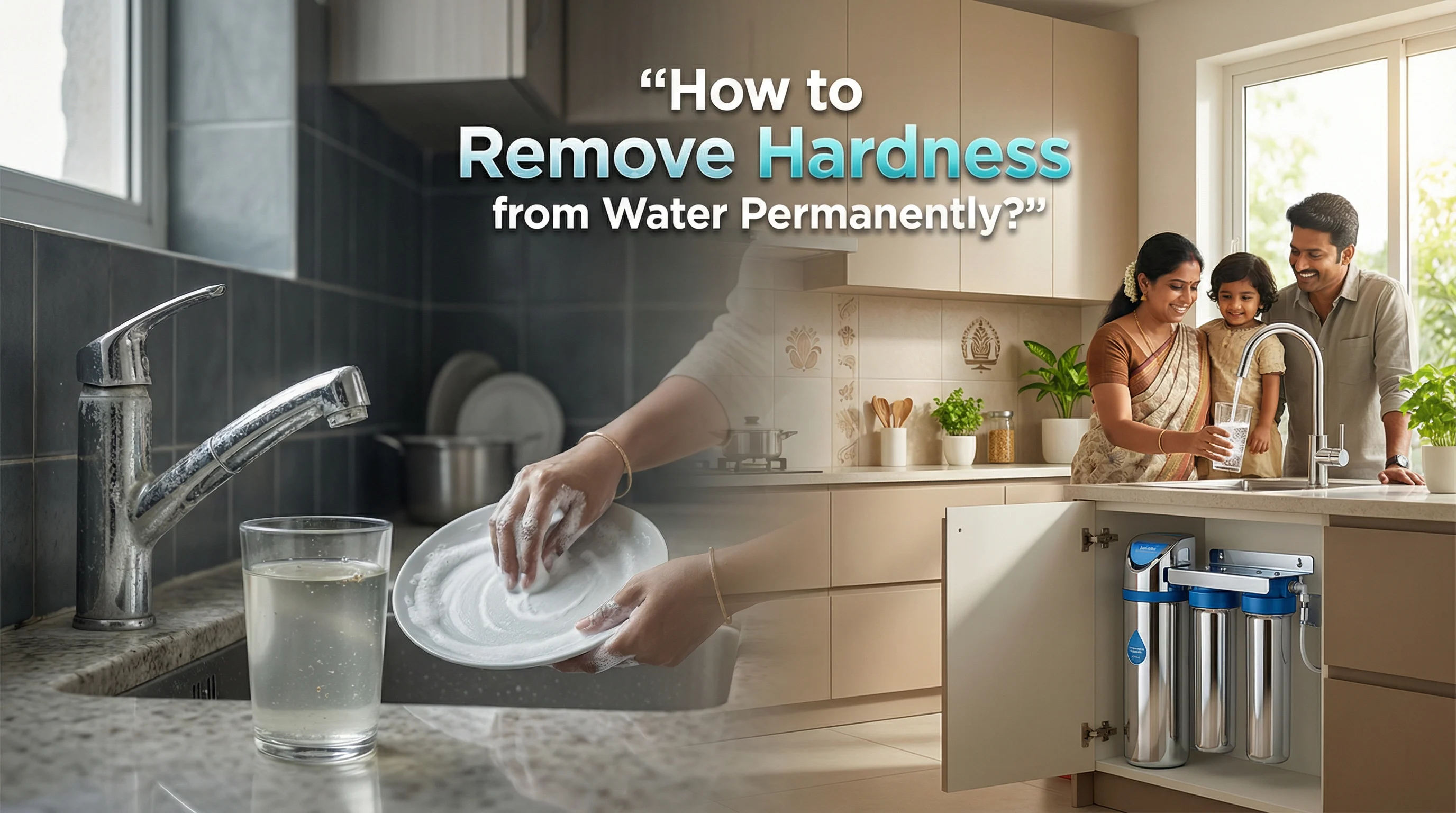
Water is essential for life, but not all water is the same. In many Indian cities and towns, including areas that depend heavily on groundwater, hard water is a common issue. If you notice white stains on taps, soap not lathering properly, dull hair, dry skin, or scale buildup in appliances, you are likely dealing with hard water.
But the real question most homeowners ask is: Can hardness be removed permanently? The answer is yes — with the right system and proper planning.
In this detailed guide, we’ll explore what causes water hardness, its effects, and the most effective long-term solutions to remove hardness permanently from your home or apartment.
What Is Hard Water?
Hard water contains high levels of dissolved minerals, mainly:
Calcium (Ca²⁺)
Magnesium (Mg²⁺)
These minerals enter the water as it passes through limestone, chalk, and mineral-rich soil. Groundwater sources, borewells, and open wells often have high hardness levels.
Types of Hardness
Temporary Hardness
- Caused by bicarbonates
- Can be removed by boiling
Permanent Hardness
- Caused by sulfates and chlorides of calcium and magnesium
- Cannot be removed by boiling
- Requires a proper water treatment solution
Most households face a combination of both, but permanent hardness is the bigger challenge.
How Hard Water Affects Your Home
Many people ignore hard water because it looks clear. However, the damage happens slowly and continuously.
1. Scale Buildup in Pipes and Appliances
Hard water forms limescale deposits inside:
Water heaters
Washing machines
Dishwashers
Pipes
Taps and showers
This reduces efficiency and increases electricity consumption.
2. Skin and Hair Problems
Hard water:
Makes skin dry and itchy
Causes hair fall and rough hair texture
Leaves soap residue on the body
3. Increased Soap and Detergent Usage
Hard water reduces soap lathering, forcing you to use more detergent for cleaning and washing.
4. Stains and Spots
You may notice:
White marks on tiles
Chalky deposits on taps
Stains on glass and utensils
Over time, maintenance costs increase significantly.
Can Hardness Be Removed Permanently?
Yes — but not with temporary methods.
Boiling or chemical additives may provide short-term relief, but they do not offer permanent solutions. For lasting results, you need a dedicated water treatment system.
Let’s look at the most effective long-term solutions.
Permanent Solutions to Remove Hardness from Water
1. Water Softener (Ion Exchange Technology)
This is the most effective and widely recommended permanent solution.
How It Works
A water softener uses ion exchange resin beads to:
Remove calcium and magnesium ions
Replace them with sodium or potassium ions
This process eliminates hardness completely.
Why It’s a Permanent Solution
Continuously removes hardness
Automatically regenerates with salt
Suitable for whole-house treatment
Protects plumbing and appliances
Best For:
Borewell water
Apartments with centralized water supply
Villas and independent houses
Commercial buildings
Maintenance Required:
Periodic salt refilling
Annual servicing
With proper maintenance, a water softener lasts 8–15 years.
2. Reverse Osmosis (RO) System
RO systems are mainly designed for drinking water purification, but they also remove hardness.
How It Works
RO uses a semi-permeable membrane to remove:
Dissolved salts
Heavy metals
Hardness minerals
TDS
Is RO a Permanent Solution?
For drinking water — Yes.
However:
It treats only drinking water
It does not soften water for bathing or washing
It may waste some water during filtration
Best used in combination with a water softener for complete protection.
3. Whole-House Water Softening Systems
For complete protection, many homeowners install:
One central water softener at the inlet
Separate RO system for kitchen drinking water
This combination ensures:
Soft water in bathrooms and appliances
Pure drinking water in kitchen
This is the most comprehensive and permanent approach.
4. Magnetic and Electronic Descalers (Not Permanent)
You may see ads for:
Magnetic water softeners
Electronic anti-scale devices
These systems:
Do not remove hardness minerals
Only alter scale formation temporarily
Results vary depending on water quality
They are not considered permanent solutions.
How to Choose the Right Hardness Removal System
Before installing any system, you must test your water.
Step 1: Check TDS and Hardness Levels
Hardness is measured in:
ppm (parts per million)
mg/L
General classification:
0–60 ppm: Soft
61–120 ppm: Moderately hard
121–180 ppm: Hard
180+ ppm: Very hard
If your water exceeds 150 ppm, a water softener is strongly recommended.
Step 2: Identify Water Source
Borewell water → Usually high hardness
Municipal water → Moderate hardness
Tanker water → Varies significantly
The source determines the required capacity.
Step 3: Calculate Daily Water Usage
Average household usage:
3–4 members → 500–800 liters/day
Apartment building → 5,000–50,000 liters/day
Choose a softener capacity accordingly.
Benefits of Removing Hardness Permanently
Installing a proper water softening system provides long-term advantages.
1. Longer Appliance Life
Soft water:
Prevents scale buildup
Reduces maintenance cost
Improves heating efficiency
2. Lower Electricity Bills
Water heaters work more efficiently without scale deposits.
3. Healthier Skin and Hair
Soft water:
Feels smooth on skin
Reduces dryness
Improves hair texture
4. Reduced Cleaning Effort
No white stains
No soap scum
Shiny tiles and glass
5. Cost Savings
Though installation has an upfront cost, you save on:
Repairs
Plumbing replacements
Extra detergent use
Appliance damage
Common Mistakes to Avoid
1. Installing Only RO for Hardness
RO treats drinking water only. It does not protect bathrooms or appliances.
2. Choosing Wrong Capacity
Undersized systems:
Regenerate too frequently
Reduce efficiency
Increase salt consumption
3. Ignoring Maintenance
Even the best system needs:
Salt refilling
Periodic resin inspection
Professional servicing
Neglecting maintenance reduces lifespan.
Common Mistakes to Avoid
1. Installing Only RO for Hardness
RO treats drinking water only. It does not protect bathrooms or appliances.
2. Choosing Wrong Capacity
Undersized systems:
Regenerate too frequently
Reduce efficiency
Increase salt consumption
3. Ignoring Maintenance
Even the best system needs:
Salt refilling
Periodic resin inspection
Professional servicing
Neglecting maintenance reduces lifespan.
How Much Does Permanent Hardness Removal Cost?
Cost depends on:
Capacity
Brand
Automation level
Installation requirements
Approximate investment:
Domestic water softener: Mid-range cost
Whole apartment system: Higher investment
RO + softener combo: Moderate to high
But compare that to:
Replacing geysers
Repairing washing machines
Plumbing scale cleaning
Tile replacement
Long-term savings outweigh initial cost.
Is It Safe to Drink Softened Water?
Softened water contains slightly higher sodium levels.
For:
Normal healthy individuals → Safe
People on low-sodium diets → Use RO for drinking
That’s why most homes combine:
Water softener for whole house
RO system for drinking water
Signs You Need a Permanent Hardness Solution
If you notice:
White scaling on taps
Geyser inefficiency
Soap not lathering
Frequent appliance repair
Dry skin and hair
Chalky deposits in kettle
It’s time to install a water softener.
Final Recommendation: What Is the Best Permanent Solution?
For complete, long-term hardness removal:
- Install a whole-house water softener
- Use an RO system for drinking water
- Test water annually
- Maintain regularly
Final Recommendation: What Is the Best Permanent Solution?
For complete, long-term hardness removal:
- Install a whole-house water softener
- Use an RO system for drinking water
- Test water annually
- Maintain regularly
This ensures:
Permanent hardness removal
Safe drinking water
Protected plumbing
Lower maintenance costs
Conclusion
Hard water may seem harmless at first, but over time, it damages appliances, plumbing, and even affects your skin and hair. Temporary fixes don’t solve the problem permanently.
The only reliable and long-term solution is installing a properly sized water softener system — preferably combined with an RO purifier for drinking water.
If your area depends on groundwater or borewell supply, addressing hardness should not be delayed. Investing in a permanent solution today will save you thousands in repair costs tomorrow — and give you the comfort of truly soft, clean water every day.
FAQ's
The most effective permanent solution is installing a water softener system that uses ion exchange technology to remove calcium and magnesium minerals responsible for hardness.
No. Boiling only removes temporary hardness caused by bicarbonates. Permanent hardness caused by sulfates and chlorides requires a water softener or RO system.
A water softener is best for removing hardness in the entire house (bathing, washing, appliances). An RO system is ideal for purifying drinking water. For complete protection, both are recommended.
Signs include white scale on taps, soap not lathering, dry skin, dull hair, appliance damage, and high TDS or hardness levels (above 150 ppm).
Water softeners require regular salt refilling (depending on usage) and professional servicing at least once a year to ensure efficient performance and long lifespan.