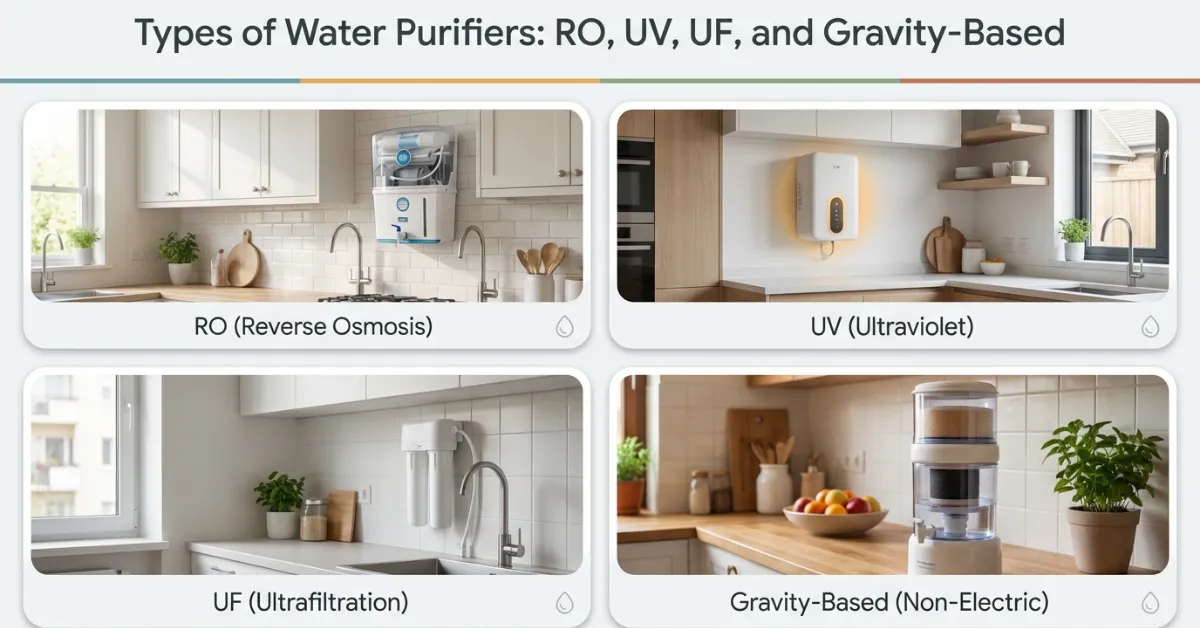
Types of Water Purifiers
Clean and safe drinking water is essential for good health. With increasing water pollution, choosing the right water purifier for your home has become more important than ever. Today, several types of purifiers are available, each designed to remove specific impurities and suit different water conditions. Let’s explore the four main types of water purifiers — RO, UV, UF, and Gravity-Based — and understand how each one works.
1. RO (Reverse Osmosis) Water Purifier
How it works:
RO purifiers use a semi-permeable membrane to remove dissolved salts, heavy metals, and harmful contaminants from water. Water is forced through the membrane under pressure, and only clean water passes through while impurities are flushed out.Best for:
- Areas with hard water (high TDS levels)
- Borewell or groundwater sources
Benefits:
- Removes dissolved salts, lead, arsenic, and other metals
- Improves taste and odor
- Ideal for urban homes with poor water quality
2. UV (Ultraviolet) Water Purifier
How it works:
UV purifiers use ultraviolet light to kill bacteria, viruses, and microorganisms in the water. It disinfects the water without using any chemicals.Best for:
- Areas with low TDS but biologically contaminated water
- Municipal tap water
Benefits:
- Kills germs and viruses effectively
- Retains essential minerals
- Low maintenance cost
3. UF (Ultrafiltration) Water Purifier
How it works:
UF purifiers use a hollow fiber membrane that filters out bacteria, cysts, and other microorganisms. Unlike RO, it doesn’t require electricity and works well with normal tap pressure.Best for:
- Areas with low TDS water
- Places with frequent power cuts
Benefits:
- Works without electricity
- Easy to maintain
- Removes visible impurities and pathogens
4. Gravity-Based Water Purifier
How it works:
These purifiers work on simple gravity (no electricity required). Water passes through layers of activated carbon and sediment filters, removing dust, sand, and certain bacteria.Best for:
- Areas with low TDS levels and clean water sources
- Rural or low-electricity areas
Benefits:
- Affordable and portable
- No electricity required
- Ideal for basic water purification needs
RO vs UV vs UF vs Gravity: Quick Comparison
| Purifier Type | Removes Microbes | Removes Dissolved Salts | Electricity Needed | Best Use Case |
| RO | Partial (better with UV) | Yes | Yes | High TDS water, borewell water |
| UV | Yes (kills bacteria/viruses) | No | Yes | Low TDS water, municipal water |
| UF | Yes | No | No | Rural water with microbial contamination |
| Gravity | Partial (depends on filter) | No | No | Low contamination, safe tap water |
How to Choose the Right Water Purifier
- Test Your Water – Use a TDS meter or water testing kit to check TDS, hardness, and microbial contamination.
- Identify Contaminants – Check for chemicals, microbes, and heavy metals.
- Check Electricity Availability – RO and UV require electricity; UF and Gravity do not.
- Consider Family Size & Budget – Factor in installation, filter replacement, and maintenance costs.
- Look for Certification – Choose purifiers certified by BIS or other recognized standards for safety and efficiency.
FAQ's
RO (Reverse Osmosis) purifiers are ideal for water with high TDS as they remove dissolved salts, heavy metals, and chemical impurities.
No. UV purifiers only kill bacteria and viruses. They do not remove dissolved salts, hardness, or chemical impurities.
No. UF purifiers work without electricity, making them suitable for areas with irregular power supply.
Gravity-based purifiers can remove some suspended particles and minor contaminants, but they are not suitable for water with high microbial contamination.
Check your water’s TDS, hardness, and microbial content. Consider electricity availability, maintenance cost, and your family’s daily water requirement before choosing RO, UV, UF, or gravity-based purifiers.

