When it comes to clean drinking water, Reverse Osmosis (RO) is one of the most trusted purification technologies. But while most of us use RO purifiers at home, very few actually know how they work. Don’t worry—this blog will break it down for you in both a technical and a simple-to-understand way.
The Simple Explanation
Think of an RO system as a super-fine strainer for water. Just like a tea strainer removes tea leaves, an RO membrane removes invisible impurities like salts, heavy metals, bacteria, and chemicals.
- You pour water in → it passes through multiple filters → impurities are trapped → clean water comes out.
- It’s like squeezing water through a net so tiny that even dissolved salts and harmful substances can’t get through.
In short: RO = Pure Water + Healthy Living.
What is Reverse Osmosis?
- Osmosis is a natural process where water moves from a region of low concentration to a region of high concentration through a semi-permeable membrane.
- Reverse Osmosis (RO) flips this process by applying pressure to push water through the membrane, leaving behind dissolved salts, chemicals, and impurities.
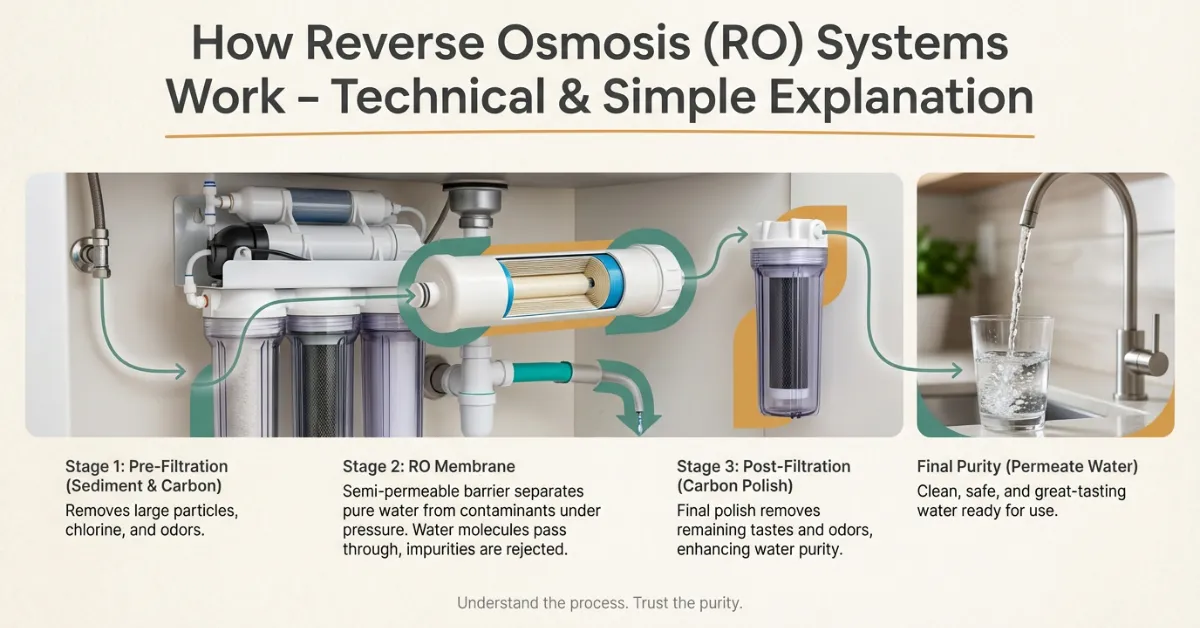
Key Components of an RO System
- Pre-Filters (Sediment & Carbon Filters)
- Removes dust, sand, chlorine, and bad odor.
- Protects the RO membrane from damage.
- RO Membrane
- The heart of the system.
- Removes dissolved salts, fluoride, arsenic, lead, mercury, and other contaminants.
- Only pure water molecules pass through.
- Post-Carbon Filter
- Polishes water to improve taste and odor.
- Polishes water to improve taste and odor.
- Storage Tank
- Stores purified water for regular use.
- Stores purified water for regular use.
How the Process Works Step by Step
- Pre-filtration – Removes larger particles and chlorine.
- High-Pressure Pump – Pushes water into the RO membrane.
- RO Membrane Filtration – Dissolved salts and heavy metals are separated.
- Post-filtration – Enhances taste and odor.
- Storage – Pure water is collected, while impurities are flushed out.
Limitations of RO Systems
- Wastes some water: About 2–3 liters of water may be wasted for every 1 liter purified.
- Removes some essential minerals: Can reduce calcium and magnesium content in water.
- Requires electricity: Unlike gravity or UF purifiers, RO depends on power.
Tip: Many modern RO systems come with TDS controllers or mineral cartridges to restore essential minerals.
Conclusion
A Reverse Osmosis (RO) system may sound complex, but at its core, it’s just a smart way of filtering water using pressure and a semi-permeable membrane. For Indian households dealing with high TDS, heavy metals, and chemical contamination, RO remains one of the most reliable water purification technologies.
After all, clean water is not just about quenching thirst—it’s about protecting health for years to come.
FAQ's
RO systems remove dissolved salts, heavy metals (like lead, arsenic, mercury), fluoride, pesticides, bacteria, and other harmful impurities.
Yes, RO water is safe. Some minerals may be reduced, but many modern RO systems include TDS controllers or mineral cartridges to retain essential minerals.
During purification, RO systems flush out concentrated impurities in wastewater. This is necessary to protect the membrane and ensure pure water output.
Pre-filters usually need replacement every 6–12 months, while the RO membrane lasts 2–3 years depending on water quality and usage.
No. RO systems require electricity to run the high-pressure pump that pushes water through the membrane.